We hope no one else uses a ladder like this chap in our photo!
Another week and another opportunity for the eagle eyed amongst us to spot another flout of Health and Safety guidelines. This week sees us in a UK town where the back of a pick up truck is being used to place a ladder in order to gain additional height.W
Of course, ladders should always be placed on a reliable surface before using them. This is for obvious reasons such as slipping or the ground itself not suitable to place a ladder such as a small area such as a porch roof.
Did you know that ladders were invented Mesolithic period, about 10,000 years ago? Cave paintings found in Valencia, Spain depict two people carrying baskets or bags. They’re using a long ladder to access a wild honeybee nest and raid it for its precious content of honey. The ladder as we know it in modern times was developed by the ancient Egyptians and ancient Hebrews.
t may come as no surprise to learn that yet again falls from height continue to result in life changing or fatal injuries in the workplace.
In June 2018 The Health and Safety Executive report that Jhanade Ryan slipped on a roof, sliding down to the edge protection. The toe board of the edge protection snapped and he fell through the scaffold, landing on a sub-station flat roof. He sustained a fracture to his spine, a broken coccyx and nerve damage. Mr Ryan was in hospital for almost three months and is now unable to work due to ongoing mobility issues.
Do you know if you’re using your ladder correctly? Read our blog to find out how.
Many people worry about using a ladder. This can be for a number of reasons, for example, height can be a barrier or just the worry that not having two feet firmly on the ground will cause them to less balanced. The truth is using a quality ladder which is being used safely and for the right purpose, is the perfect tool for working at height.
In fact, accidents on ladders often occur because risks were taken in the first place – over reaching or placing the ladder in an inappropriate position are the most common causes of accident.
We hope you find this blog useful! Please leave us any feedback.
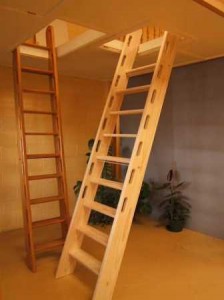
Just do a quick internet search on building regulations in the UK and you will see a confusing myriad of UK local authority laws that govern the use and erection of loft ladders, loft stairs and loft conversions.
For example, why must loft stairs conform to building regulations, while there is no such requirement for loft ladders? This is because local authorities see the installation of a stairway as the beginning of a process to use a loft as a living space, rather than storage space. In this case, the regulations are more stringent.
Loft areas that are used for storage generally aren’t accessed often. This is different from accessing a loft that’s been converted into living space that people will need to access frequently, such as a sleeping or study area. With more frequent use comes a greater chance of an accident.
So, the enhanced building regulations exist to prevent injuries and to ensure the conversion proceeds according to all relevant rules and standards.
Have you ever struggled to carry a heavy or bulky item up to your loft? Chances are, then, that you may have noticed how rickety and inadequate your current loft ladder is. Loft ladders don’t always seem to be designed for heavy or frequent use.
If this is the case with yours, or if you’re considering upgrading your loft from storage space to living space, there are a number of important issues to consider. It’s wise to have a plan because if you’ve ever tried to do a major home renovation without one, then you’re very well aware how difficult it can be.
Do you know the facts relating to scaffold towers? We have published a blog ‘History of the Trusty Scaffold Tower’ to give you all a bit more of an insight into how, when and why they were invented.
When were scaffold towers invented?. Many people think that Scaffolds are a recent invention, where in fact they were used in ancient Greece at least 500 years BC. Records of ancient cultures in Egypt, Nubia and China indicate that these cultures used scaffolds extensively. Many early African cultures made use of scaffolds too. To reach the apex of the Sistine Chapel, Michelangelo designed his own scaffold, which was unique because instead of being deployed on the floor, he built his scaffold on brackets that were fitted into holes near the top of the chapel’s windows.
To help working at height, a scaffold tower is often used instead of scaffolds. These are free-standing systems that are easy to move and adjust. A typical scaffold tower is fitted with castors that allow it to be moved quickly and easily. The castors lock securely into place when the tower is in use. Work platforms are accessed by internal ladders.
We published this blog ‘Wooden Ladders Vs Aluminium Ladders’ to point out the key features, characteristics and highlights to make you aware of the difference and importance between the two.
Have you ever struggled with a heavy timber ladder? If so, then you know that setting up a large one, such as a two or three sections can be difficult for one person to handle. Many people have discovered that switching to lightweight and durable aluminium ladders is a good solution. However, there are a few points to be aware of when considering an aluminium ladder.
If you’re shopping for an aluminium ladder, then the best way to find one that is well suited to your needs is to be familiar with the properties of the metal from which they’re made. Whether it’s a step ladder, loft ladder, an extension ladder or one of those handy multi-purpose ladders, choosing one made from aluminium is right for a number of reasons. First, make sure that the ladder you buy is resistant to rust and corrosion, like an aluminium ladder.
We are a family run business and have been supplying the trade and public with quality ladders, loft ladders and scaffold towers for many years.
Our primary aim is to ensure that we provide a quick and friendly service to our customers, many of whom return to us to purchase other products at a later date, or recommend us to their friends and family. We recognise the importance of providing excellent customer care and have carefully selected our staff with this in mind. Our staff have many years experience and will be able to answer any questions that you have on our products.
Importantly, we recognise that our customers are looking for quality products and excellent value for money. We have assembled a unique range of access equipment which we believe provides just that. Our products carry the latest safety kite mark, where appropriate, and we regularly trawl the internet to ensure that we offer the most competitive prices around.




 BPS Access Solutions Ltd